
How to Negotiate Parcel Rates: A Data-Based Playbook
Key answer: Prepare for parcel rate negotiations by analyzing shipment history, identifying the largest cost drivers and comparing proposals on the same shipment sample. Evaluate minimums, surcharges and service requirements alongside discounts, then verify that the agreed terms appear on invoices.
If your shipment profile or carrier pricing has changed, review the agreement using current data. Published general rate increases vary by year and do not represent the exact change to your own invoice.
Carrier negotiations work best when you understand the terms driving your costs. This guide explains how to prepare shipment data, compare proposals and verify implementation.
Why Most Shippers Leave Money on the Table
A formal review can reveal opportunities that a renewal based only on headline discounts misses. Begin with the current agreement and a representative shipment history.
A carrier proposal reflects its commercial terms, but your team still needs to assess whether it meets your cost and service requirements. Benchmark comparable shipment profiles and model your own net charges.
This is the core principle behind data-driven negotiation: your shipping data is your leverage. The more granularly you understand your spend, the more precisely you can target concessions where they’ll have the biggest impact.
The 5-Step Parcel Rate Negotiation Framework
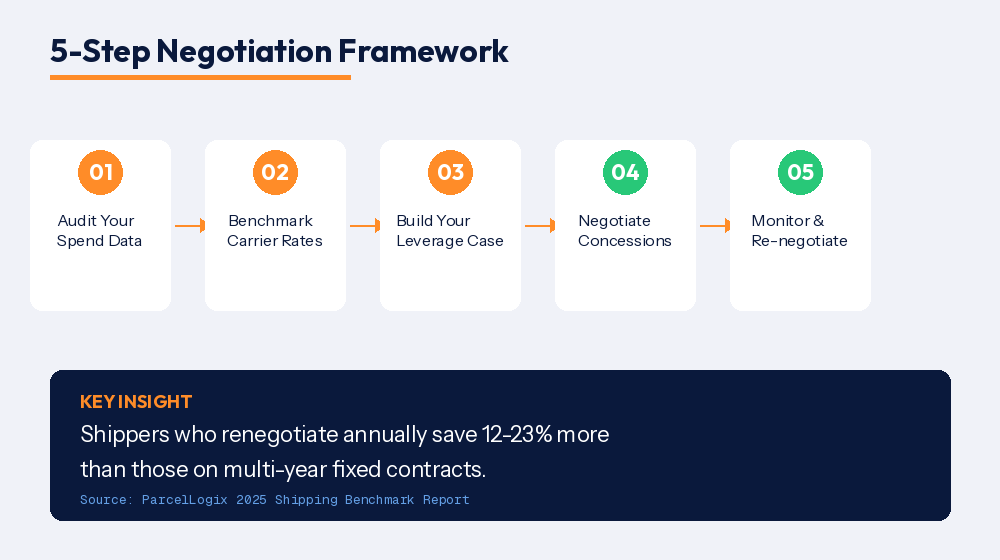
Step 1: Audit Your Current Spend
Before you can negotiate effectively, you need to understand exactly where your money goes. Pull 12 months of shipping invoices and break them down by carrier and service level, package weight and dimensions, zone distribution, surcharges and accessorials, and delivery performance metrics.
Separate surcharges from transportation charges and rank them by annual cost. Prioritize the fees that materially affect your own shipping profile.
ParcelLytics is ParcelLogix’s parcel spend analytics platform. Ask the team to demonstrate the data sources, reports and review workflows relevant to your operation.
Step 2: Benchmark Against Market Rates
A discount off published rates needs context. Rate bases, minimum charges, fee provisions and shipment mix can make two similar discounts produce different invoice totals.
Benchmarking is where most shippers get stuck because carrier pricing is deliberately opaque — there’s no public database of negotiated rates. This is exactly why working with a parcel spend optimization partner is so valuable. Firms like ParcelLogix maintain benchmarking databases across thousands of shipping profiles, giving you a clear picture of what “competitive” actually means for your specific situation.
At minimum, you should benchmark base rate discounts by service level, earned discount tiers and thresholds, minimum charge levels, DIM divisor (139 is standard — many shippers negotiate higher), and individual surcharge caps or waivers.
Step 3: Build Your Leverage Case
Carriers don’t give better rates out of goodwill — they respond to data-backed leverage. The strongest leverage points include competitive pressure (having quotes from alternative carriers), volume growth projections, favorable package characteristics (consistent weights, standard dimensions, commercial addresses), historical on-time performance and low claims rate, and willingness to consolidate volume.
One overlooked strategy: comparing major carriers isn’t just about finding the cheapest option. Even if you prefer FedEx, getting a competitive UPS quote gives your FedEx rep the internal justification to approve deeper discounts.
Step 4: Negotiate Specific Concessions
This is where the data pays off. Rather than asking your carrier for “better rates” (which gets you a marginal improvement), target specific concessions based on your spend analysis. For high-volume Ground shippers, negotiate base rate discounts and minimum charge elimination. If residential delivery is a major cost center, push for residential surcharge caps or waivers. For shippers with lightweight, bulky products, a higher DIM divisor (166 instead of 139) can save thousands.
Don’t forget to negotiate accessorial fee caps. Carriers are often more flexible on surcharges than base rates because surcharges are less visible in competitive comparisons.
Step 5: Monitor, Audit, and Re-Negotiate
After signing, verify the agreement’s effective date, account coverage and billed charges. Investigate discrepancies and distinguish contract errors from changes in shipment mix or published fees.
Set a recurring invoice-review schedule and review the agreement when your business or carrier terms change. Confirm the coverage and processing frequency of any auditing software.
What Data Should You Present to Your Carrier?
When you sit down with your carrier rep, come prepared with your complete shipping profile including monthly volume by service level, average package weight and dimensions, zone distribution heat map, and percentage of residential vs. commercial deliveries.
You should also have your spend breakdown showing total spend by category (base rates, fuel, surcharges, accessorials), year-over-year spend growth, and top 10 surcharges by dollar impact. Competitive intelligence matters too — alternative carrier quotes (even preliminary ones), regional carrier options for specific lanes, and consolidator or 3PL pricing for comparison.
Finally, bring your performance data: on-time delivery rates, claims frequency, and customer satisfaction scores tied to shipping. The more professional and data-complete your presentation, the more seriously your carrier rep will take the negotiation — and the better your results.
Common Negotiation Mistakes to Avoid
Common errors include accepting a proposal without comparison, ignoring surcharges, overlooking rate-change language and failing to check implementation. Further concessions may not be available, so evaluate each written proposal on its own merits.
How ParcelLogix Makes This Easier
Most businesses don’t have the time, tools, or benchmarking data to run this process in-house. That’s where we come in. ParcelLogix provides end-to-end parcel spend optimization — from the initial data audit through negotiation strategy, carrier benchmarking, and ongoing contract monitoring.
ParcelLogix combines carrier contract analysis and negotiation with ParcelLytics spend visibility. We estimate opportunities from your own data and agree how implementation and savings will be measured.
Ready to Stop Overpaying for Shipping?
Get a free parcel spend analysis and find out exactly how much you could save.
Key Takeaways
Parcel rate negotiation isn’t a one-time event — it’s an ongoing discipline. The shippers who save the most are the ones who treat their carrier relationships as strategic partnerships backed by data, not passive vendor relationships. Audit your spend annually, benchmark against the market, negotiate specific concessions (not vague “better rates”), and monitor your contract for compliance. Whether you handle this in-house or work with a partner like ParcelLogix, the data-driven approach consistently outperforms gut-feel negotiation by a wide margin.
Related reading: