
Dimensional Weight: Formula, Examples & Cost Review
Key answer: Dimensional weight measures package volume for pricing. Calculate length × width × height, divide by the applicable divisor, and apply the service’s rounding and billing rules. Compare the result with actual weight; a higher dimensional weight can increase billed weight without indicating an invoice error.
Dimensional weight prices a package using the space it occupies. A lightweight parcel can therefore have a billed weight above its actual weight. Understanding the calculation helps you compare packaging and contract options without assuming every difference is a billing error.
Understanding how dimensional weight works — and knowing how to negotiate around it — is one of the highest-impact moves you can make to reduce your total parcel spend.
What Is Dimensional Weight?
Dimensional weight (also called DIM weight or volumetric weight) is a pricing technique that carriers use to account for the space a package occupies in their vehicles, not just its actual weight. The logic is simple from the carrier’s perspective: a truck or aircraft can only hold so many packages by volume before running out of space, even if it hasn’t reached its weight capacity. DIM weight pricing ensures that lightweight, bulky packages pay their fair share for the space they consume.
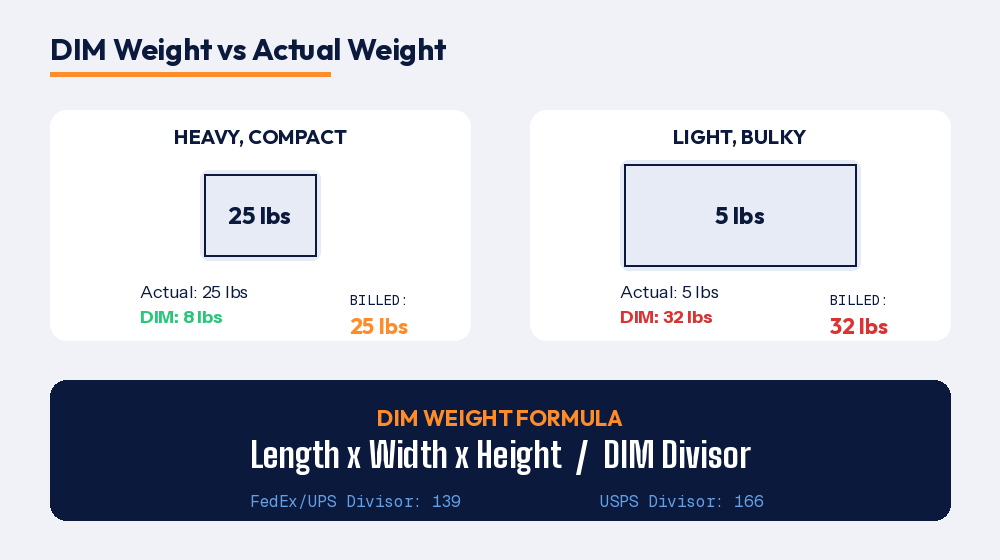
The formula is straightforward: DIM Weight = (Length × Width × Height) ÷ DIM Divisor. The carrier then charges based on whichever is greater — the actual weight or the DIM weight.
DIM Divisors by Carrier
The DIM divisor is the magic number that determines how aggressively dimensional weight affects your bills. A lower divisor means higher DIM weights (and higher costs). Here’s where the major carriers stand in 2026:
The applicable dimensional-weight divisor depends on the carrier, service, rate type and agreement. UPS publishes 139 for Daily Rates and 166 for Retail Rates. Check UPS dimensional-weight rules and FedEx dimensional-weight guidance before calculating a shipment; do not assume one divisor applies to every service.
A different DIM provision may be available through negotiation, but availability and benefit depend on the agreement. Re-rate affected shipments to quantify the opportunity; do not infer dollar savings from a change in divisor alone.
How to Calculate Your DIM Weight Exposure
Not every package in your mix is affected by DIM weight. To understand your exposure, you need to identify which packages have a DIM weight that exceeds their actual weight — those are the ones costing you extra.
Pull package dimensions and actual weights, then calculate dimensional weight under the relevant service and agreement. Prioritize the measured dollar impact of affected shipments rather than a universal percentage threshold.
Use parcel analytics to investigate billed versus actual weight. Ask the ParcelLogix team to demonstrate the available data and reporting for your shipment profile before relying on an automated calculation.
5 Strategies to Reduce DIM Weight Costs
1. Negotiate a Higher DIM Divisor
If dimensional pricing materially affects your spend, ask whether alternative provisions are available. Compare the total cost under the proposal before deciding whether it improves the agreement.
2. Right-Size Your Packaging
Right-sized packaging can reduce dimensional weight on affected shipments. Test the effect on billed cost, materials, packing labor and product protection before changing packaging.
3. Use Carrier-Provided Packaging
Carrier-provided packaging may have service-specific pricing and eligibility rules. Confirm the permitted service, contents, weight limits and current charge rules before changing packaging.
4. Diversify Across Carriers
Compare dimensional-weight rules across eligible services using the same shipment sample. A larger divisor alone does not establish which carrier has the lowest total cost.
5. Audit for DIM Weight Billing Errors
If billed dimensions differ from your records, investigate the measured package, applicable rounding rules and agreement. Keep supporting measurements and follow the carrier’s adjustment process for a documented discrepancy.
Illustrative DIM Weight Calculation
Illustrative calculation: a 12 × 12 × 12 inch package has a volume of 1,728 cubic inches. Dividing by 139 gives 12.43 pounds, rounded up to 13; dividing by 166 gives 10.41 pounds, rounded up to 11. These are hypothetical dimensional weights, not a customer case study.
For that example, compare the resulting dimensional weight with actual weight and apply the relevant service’s rounding, minimum billable weight and rate rules. A change from 13 to 11 billable pounds does not mean the shipping price falls by the same percentage.
This is exactly the type of analysis that ParcelLogix’s spend optimization team runs for every client. Most shippers have no idea how much DIM weight is actually costing them until someone does the math.
How Much Is DIM Weight Costing You?
Request a free parcel savings assessment and discuss whether dimensional-weight analysis fits your shipment profile.
Related reading:
- The Hidden Fees Destroying Your Shipping Budget
- Accessorial Charges in Parcel Shipping
- How to Control UPS & FedEx Costs
- Why Your Shipping Contract Isn’t Saving You Money
How does dimensional weight affect a carrier proposal?
Include the dimensions and actual weight of each representative package in your proposal comparison. A lower divisor can increase billed weight for some boxes; a better transportation discount may not offset the resulting cost. Packaging changes also need a total-cost comparison that includes materials, handling and protection in transit.
Separate three findings: a correct dimensional charge that could be reduced through packaging, a different divisor available under a written proposal, and a measurement or billing error supported by evidence. They lead to different actions and should not be added together as guaranteed savings. See the invoice audit checklist for billing checks and the proposal comparison guide for evaluating net cost.