
How to Negotiate Parcel Rates: The Data-Driven Playbook
If you’re shipping more than a few hundred packages per week and you haven’t renegotiated your carrier contract in the last 12 months, you’re almost certainly overpaying. FedEx and UPS raise their published rates by 5.9% on average every year — but those General Rate Increases (GRIs) don’t tell the whole story. When you factor in surcharge inflation, accessorial fee creep, and DIM weight adjustments, your effective shipping cost increase can be 8–12% annually.
The good news? Carrier contracts are far more negotiable than most shippers realize. In this guide, we’ll walk through the exact data-driven process that helps ParcelLogix clients reduce their parcel spend by 15–30% — without switching carriers or cutting service levels.
Why Most Shippers Leave Money on the Table
Here’s a stat that surprises most logistics managers: fewer than 30% of mid-market shippers have ever formally negotiated their parcel contract. Most simply accept the “standard discount” their carrier rep offers and sign for two or three years.
The problem is that carrier reps are trained to offer just enough savings to close the deal — not the maximum discount your shipping profile actually warrants. Without your own data analysis backing the conversation, you have no way to know whether a 40% discount off published rates is competitive or whether you should be getting 55%.
This is the core principle behind data-driven negotiation: your shipping data is your leverage. The more granularly you understand your spend, the more precisely you can target concessions where they’ll have the biggest impact.
The 5-Step Parcel Rate Negotiation Framework
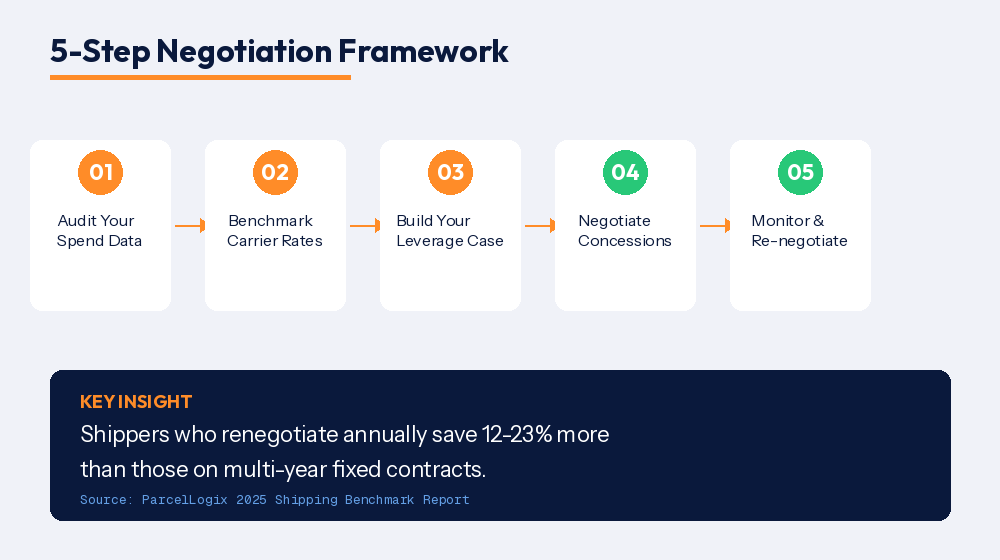
Step 1: Audit Your Current Spend
Before you can negotiate effectively, you need to understand exactly where your money goes. Pull 12 months of shipping invoices and break them down by carrier and service level, package weight and dimensions, zone distribution, surcharges and accessorials, and delivery performance metrics.
Most shippers are shocked to discover that surcharges account for 30–40% of their total parcel spend. Fuel surcharges, residential delivery fees, additional handling charges, and peak surcharges add up fast — and they’re often the most negotiable line items in your contract.
If you don’t have tools to break down your invoices at this level, ParcelLytics can automate the entire analysis and surface savings opportunities you’d never find manually.
Step 2: Benchmark Against Market Rates
Your discount off published rates means nothing in isolation. A 50% discount on Ground sounds great until you realize that shippers with similar volumes and profiles are getting 62%.
Benchmarking is where most shippers get stuck because carrier pricing is deliberately opaque — there’s no public database of negotiated rates. This is exactly why working with a parcel spend optimization partner is so valuable. Firms like ParcelLogix maintain benchmarking databases across thousands of shipping profiles, giving you a clear picture of what “competitive” actually means for your specific situation.
At minimum, you should benchmark base rate discounts by service level, earned discount tiers and thresholds, minimum charge levels, DIM divisor (139 is standard — many shippers negotiate higher), and individual surcharge caps or waivers.
Step 3: Build Your Leverage Case
Carriers don’t give better rates out of goodwill — they respond to data-backed leverage. The strongest leverage points include competitive pressure (having quotes from alternative carriers), volume growth projections, favorable package characteristics (consistent weights, standard dimensions, commercial addresses), historical on-time performance and low claims rate, and willingness to consolidate volume.
One overlooked strategy: comparing major carriers isn’t just about finding the cheapest option. Even if you prefer FedEx, getting a competitive UPS quote gives your FedEx rep the internal justification to approve deeper discounts.
Step 4: Negotiate Specific Concessions
This is where the data pays off. Rather than asking your carrier for “better rates” (which gets you a marginal improvement), target specific concessions based on your spend analysis. For high-volume Ground shippers, negotiate base rate discounts and minimum charge elimination. If residential delivery is a major cost center, push for residential surcharge caps or waivers. For shippers with lightweight, bulky products, a higher DIM divisor (166 instead of 139) can save thousands.
Don’t forget to negotiate accessorial fee caps. Carriers are often more flexible on surcharges than base rates because surcharges are less visible in competitive comparisons.
Step 5: Monitor, Audit, and Re-Negotiate
Signing a new contract isn’t the finish line — it’s the starting point of ongoing optimization. Carrier pricing structures are complex, and contract compliance issues are surprisingly common. Billing errors, incorrectly applied surcharges, and missed service guarantees can erode your negotiated savings by 3–7% annually.
Set up automated invoice auditing to catch discrepancies in real-time. And plan to renegotiate at least annually — your shipping profile changes, carrier pricing evolves, and rate increases accumulate faster than most businesses realize.
What Data Should You Present to Your Carrier?
When you sit down with your carrier rep, come prepared with your complete shipping profile including monthly volume by service level, average package weight and dimensions, zone distribution heat map, and percentage of residential vs. commercial deliveries.
You should also have your spend breakdown showing total spend by category (base rates, fuel, surcharges, accessorials), year-over-year spend growth, and top 10 surcharges by dollar impact. Competitive intelligence matters too — alternative carrier quotes (even preliminary ones), regional carrier options for specific lanes, and consolidator or 3PL pricing for comparison.
Finally, bring your performance data: on-time delivery rates, claims frequency, and customer satisfaction scores tied to shipping. The more professional and data-complete your presentation, the more seriously your carrier rep will take the negotiation — and the better your results.
Common Negotiation Mistakes to Avoid
Even experienced logistics teams make costly errors during contract negotiations. The biggest ones we see at ParcelLogix include accepting the first offer (carrier reps always have room to go deeper), focusing only on base rates while ignoring surcharges, signing multi-year contracts without annual rate review clauses (see our analysis of why long-term carrier agreements can backfire), not reading the legal language in your contract, and failing to track whether negotiated rates are actually being applied correctly.
How ParcelLogix Makes This Easier
Most businesses don’t have the time, tools, or benchmarking data to run this process in-house. That’s where we come in. ParcelLogix provides end-to-end parcel spend optimization — from the initial data audit through negotiation strategy, carrier benchmarking, and ongoing contract monitoring.
Our clients typically see 15–30% reductions in total parcel spend within the first 90 days, and our ParcelLytics platform ensures those savings stick through automated invoice auditing and real-time spend visibility.
Ready to Stop Overpaying for Shipping?
Get a free parcel spend analysis and find out exactly how much you could save.
Key Takeaways
Parcel rate negotiation isn’t a one-time event — it’s an ongoing discipline. The shippers who save the most are the ones who treat their carrier relationships as strategic partnerships backed by data, not passive vendor relationships. Audit your spend annually, benchmark against the market, negotiate specific concessions (not vague “better rates”), and monitor your contract for compliance. Whether you handle this in-house or work with a partner like ParcelLogix, the data-driven approach consistently outperforms gut-feel negotiation by a wide margin.
Related reading: