
Can AI Optimize Your Parcel Shipping Costs?
Artificial intelligence is reshaping every corner of supply chain management, and parcel shipping is no exception. But between the genuine innovations and the marketing hype, it can be hard to know what AI can actually do for your shipping costs today — and what’s still vaporware.
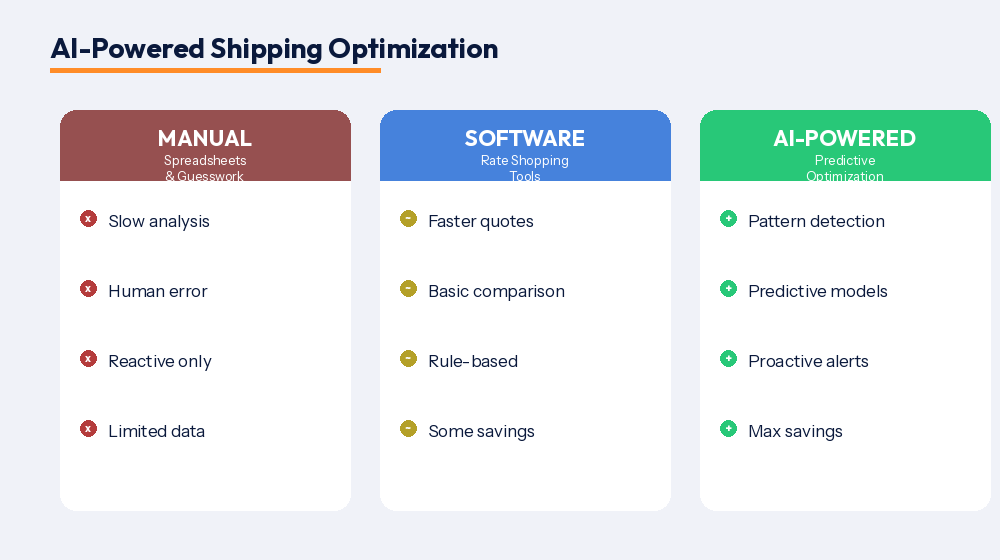
The short answer: AI is already delivering measurable savings for shippers who use it correctly, primarily through pattern detection in shipping data, predictive cost modeling, automated invoice auditing, and real-time carrier selection optimization. Let’s break down what’s real, what’s emerging, and how to evaluate AI-powered shipping tools for your business.
Where AI Actually Excels in Parcel Shipping
Pattern Detection and Spend Analysis
The most immediate value AI brings to parcel shipping is its ability to analyze vast datasets and find patterns that humans miss. A typical mid-market shipper generates millions of data points per year across carriers, service levels, zones, package dimensions, surcharges, and delivery outcomes. Spreadsheet analysis can handle the basics, but AI excels at identifying non-obvious correlations — like discovering that packages shipped on Tuesdays to Zone 5 consistently get billed at incorrect DIM weights, or that a specific product category triggers disproportionate accessorial charges.
At ParcelLogix, our ParcelLytics platform uses machine learning models trained on billions of shipment records to benchmark your rates, identify anomalies, and surface savings opportunities that traditional analysis tools simply can’t find at the same speed or scale.
Automated Invoice Auditing
Carrier billing errors are more common than most shippers realize. Studies consistently show that 2–5% of parcel invoices contain errors — incorrect surcharges, wrong service levels billed, missed contractual discounts, or weight/dimension discrepancies. For a shipper spending $5 million annually on parcel, that’s $100,000–$250,000 in recoverable overcharges.
AI-powered auditing tools can scan every invoice line against your contract terms, flag discrepancies in real-time, and even automate the claims filing process. This is one area where AI has clearly surpassed manual auditing — it’s faster, more comprehensive, and catches errors that human reviewers miss. Maintaining contract compliance becomes proactive rather than reactive.
Predictive Cost Modeling
One of the most powerful AI applications is forecasting what your shipping costs will look like under different scenarios. Planning a new product launch? AI can model the cost impact based on projected package dimensions, destination zones, and seasonal demand patterns. Considering switching from FedEx to UPS for a portion of your volume? Predictive models can estimate the total cost impact — including surcharges, DIM weight differences, and service level tradeoffs — before you make the switch.
This capability is transformative for contract negotiations. Instead of going to the table with historical data alone, you can model exactly what specific concessions are worth to your business, helping you prioritize which rate elements to negotiate hardest on.
Carrier Selection Optimization
For shippers using multiple carriers, AI can optimize carrier selection at the package level — routing each shipment to the carrier that offers the best combination of cost, speed, and reliability for that specific package’s characteristics and destination. This goes beyond simple rate shopping: AI models factor in historical delivery performance, surcharge patterns, DIM weight treatment, and even carrier capacity constraints to make truly optimized routing decisions.
The savings from intelligent carrier routing typically range from 5–15% on top of whatever contract discounts you’ve already negotiated. Comparing carriers manually for each shipment is impractical at scale, but AI makes per-package optimization feasible.
What AI Can’t Do (Yet)
It’s important to have realistic expectations. AI is not a replacement for human negotiation strategy. Carrier reps respond to relationship dynamics, business context, and competitive pressure in ways that algorithms can’t replicate. What AI does is arm you with better data and analysis to make those human negotiations more effective.
AI also struggles with truly novel situations — unprecedented market disruptions, new carrier programs with no historical data, or unique business requirements that don’t fit standard patterns. The best approach combines AI-powered analytics with experienced parcel spend optimization professionals who can interpret the data and translate it into negotiation strategy.
Evaluating AI Shipping Tools: What to Look For
The market is flooded with tools claiming “AI-powered” shipping optimization. Here’s how to separate substance from marketing. Look for tools that provide transparent methodology (how does the AI actually work, not just “proprietary algorithms”), carrier-agnostic analysis (tools tied to a single carrier have inherent bias), historical benchmarking against real shipper data (not just published rate cards), ongoing monitoring rather than point-in-time analysis, and integration with your actual shipping data (not just estimates based on volume averages).
Ask vendors for specific case studies with measurable results, and be wary of any tool that promises savings without analyzing your actual shipping data first. Read about the common mistakes businesses make with parcel contracts to understand what good optimization looks like.
How ParcelLogix Uses AI for Your Benefit
Our approach combines AI-powered analytics with hands-on expertise. The ParcelLytics platform handles the heavy lifting — processing your shipping data, benchmarking against our database, identifying anomalies, and modeling scenarios. Our optimization team then translates those insights into actionable negotiation strategies and ongoing cost management.
This hybrid approach consistently outperforms pure-software solutions because shipping optimization isn’t just a data problem — it’s a business strategy problem that requires understanding your operations, your carrier relationships, and the competitive dynamics of the parcel market.
See AI-Powered Shipping Optimization in Action
Book a demo of ParcelLytics and discover what AI can find in your shipping data.
Related reading: