
Small Business Parcel Rates: How to Compare Costs

Key answer: Small businesses can compare account pricing, consolidator options and regional carriers using their actual shipments. Package count alone does not establish a competitive rate. Include minimum charges, surcharges, pickup costs and delivery requirements in the comparison.
If you’re a small or mid-size business shipping fewer than 5,000 packages per week, you might assume you’re stuck with whatever rates FedEx or UPS offer you. After all, the biggest discounts go to the biggest shippers, right?
Smaller shippers can compare published account programs, consolidator pricing and eligible regional services. Available terms depend on the shipment profile and provider; a weekly package count does not guarantee enterprise-level savings.
The Small Business Shipping Landscape in 2026
The parcel market offers national, regional and alternative networks. Evaluate current pickup and destination coverage, service commitments and total cost. Pandion closed in January 2025 and should not be considered an available new carrier; see our carrier status information.
For small businesses, this means more leverage than you think. FedEx and UPS are actively competing for small-to-midsize accounts because they’re losing some of that volume to alternatives. Your willingness to consider (or actually use) alternative carriers gives you negotiating power that pure volume cannot.
7 Strategies for Getting Better Rates
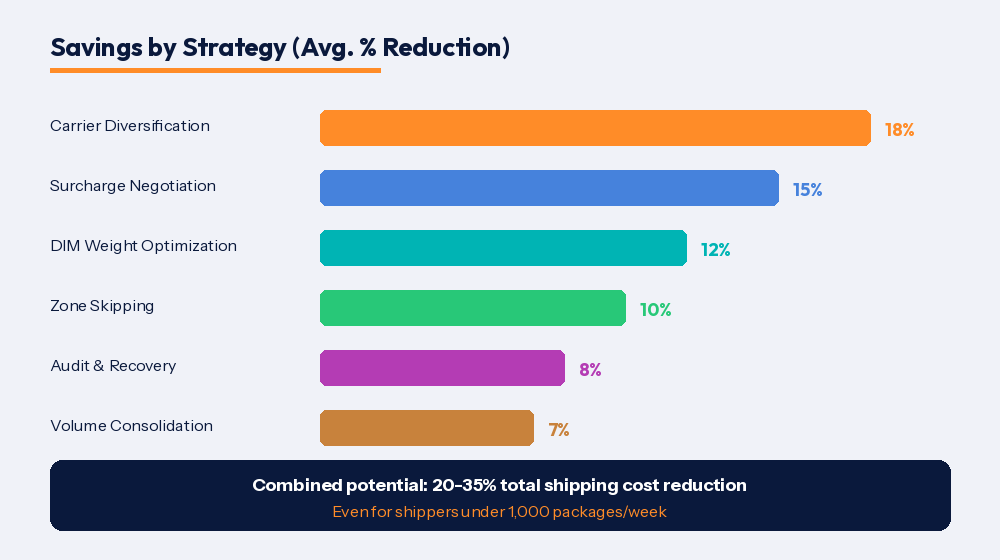
1. Diversify Across Carriers
Evaluate whether a multi-carrier strategy fits your operation. Price eligible shipments across providers, then include integration costs, pickup requirements and changes to existing incentive tiers before moving volume.
2. Negotiate Surcharges First, Base Rates Second
This might be counterintuitive, but for small businesses, surcharge negotiation often yields bigger savings than base rate negotiation. Why? Because carriers expect small shippers to ask for base rate discounts, and their reps have tight guidelines on what they can offer. But surcharges are less visible in competitive comparisons, which means carrier reps often have more flexibility to waive or reduce them.
Focus on the surcharges that hit your specific shipping profile hardest. If you ship primarily residential, push for residential surcharge reductions. If your products are bulky, negotiate the DIM divisor. If you ship to rural areas, target delivery area surcharges. See our complete guide to accessorial charges for the full breakdown.
3. Use a Shipping Consolidator or 3PL
Consolidators aggregate volume from hundreds of small shippers to negotiate enterprise-level rates, then pass a portion of those savings to their customers. For businesses shipping 200–2,000 packages per week, this can be the fastest path to competitive pricing. The tradeoff is that you may have less control over carrier selection and some consolidators lock you into specific service levels.
Evaluate consolidator options carefully — not all pass through the same level of savings, and some charge fees that eat into the rate benefit. ParcelLogix can help you evaluate whether a consolidator, direct carrier contract, or hybrid approach is most cost-effective for your specific volume and shipping profile.
4. Time Your Negotiations Strategically
Carrier reps have quotas and sales cycles. The best times to negotiate are Q4 (when reps are trying to close annual numbers), immediately after a GRI announcement (when shippers are most likely to switch), and when your contract is 60–90 days from renewal. Avoid negotiating during peak season (November–January) when carriers have maximum leverage and minimum incentive to discount.
Also consider that long-term carrier agreements can backfire for small businesses whose volume is growing. A one-year contract with annual renegotiation protects your ability to leverage volume growth into better rates.
5. Optimize Your Packaging
Right-sized packaging can reduce dimensional weight, but include packaging materials, packing labor, testing and damage rates in the comparison. Measure the net effect on your own shipment data.
6. Audit Every Invoice
Small businesses are more likely to have billing errors go undetected because they lack dedicated logistics staff reviewing invoices line by line. Set up automated auditing — even basic tools can catch the most common errors like incorrect surcharges, wrong weight charges, and late deliveries eligible for guaranteed service refunds. For context on what to look for, see our piece on why your shipping contract isn’t saving you money.
7. Leverage Data (Even Small Datasets)
You don’t need 100,000 shipments per month to do meaningful analysis. Even 500 packages per week generates enough data to identify your zone distribution, DIM weight exposure, surcharge breakdown, and carrier performance metrics. This data turns a “please give us better rates” conversation into a professional, data-backed negotiation that carrier reps take seriously. Read our 7 tips for successful parcel contract negotiations for the complete playbook.
What Rates Should Small Businesses Expect?
There is no reliable universal target discount or DIM divisor based only on weekly package count. Compare written proposals on your actual services, zones, weights, dimensions and surcharge exposure. A higher percentage discount does not necessarily mean a lower invoice.
These are achievable targets, not aspirational ones. If your current contract is significantly worse than these benchmarks, there’s room to negotiate — and ParcelLogix specializes in helping small businesses close that gap.
Find Out If You’re Overpaying
Get a free rate benchmark for your business — no commitment, no pressure.
Related reading: