
Accessorial Charges: Hidden Parcel Fees
Your finance team approved a shipping budget based on quoted carrier rates. You negotiated volume discounts with UPS, FedEx, or DHL. You selected service levels that balance cost and speed. Everything looked reasonable on paper.
Three months later, your actual shipping costs are running thirty percent over budget. Nobody can explain why.
The culprit? Accessorial charges. These additional fees slip onto invoices with minimal visibility, compounding month after month until they represent a significant portion of your total shipping spend. Most companies track their base rates obsessively while accessorial charges escape scrutiny entirely — creating a blind spot that quietly drains profitability.
What Are Parcel Accessorial Charges?
Accessorial charges are additional fees assessed by parcel carriers like UPS, FedEx, DHL, and regional carriers for services beyond standard pickup and delivery. These surcharges cover situations that require extra handling, time, or resources — such as residential deliveries, address corrections, oversized packages, and fuel cost fluctuations.
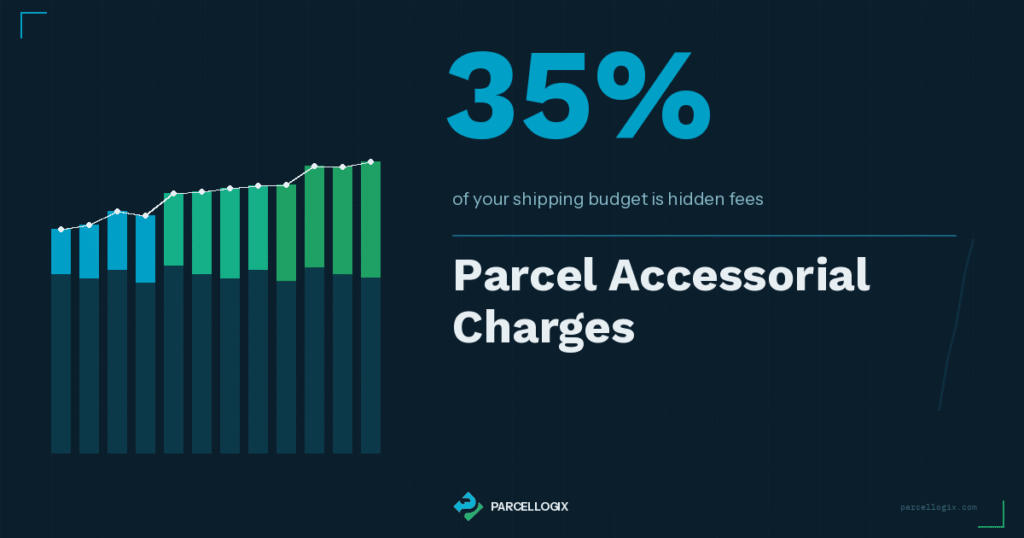
Industry data from Reveel shows that accessorial fees typically represent 20–35% of total parcel shipping spend, and can reach 40% during peak seasons or for poorly managed shipping profiles. For a company spending $500,000 annually on shipping, that’s potentially $100,000 to $200,000 in surcharges alone.
Carriers maintain extensive fee schedules with dozens of different accessorial charges. Each comes with specific triggers and pricing that change regularly — sometimes multiple times per year. Understanding when these fees apply, whether they’re legitimate, and whether they’re priced according to your contract requires detailed knowledge that most shipping operations don’t maintain.
The problem isn’t that accessorial charges exist. Some are legitimate costs of complex logistics. The problem is how they’re applied, how aggressively they’re priced, and how difficult they are to track and control. Many shippers who negotiate strong base rate discounts still get blindsided by surcharges that erode those savings entirely.
The Most Common Parcel Accessorial Charges and What They Cost
Residential Delivery Surcharges
Every package going to a home address gets hit with a residential delivery surcharge. Carriers charge more because residential deliveries are less efficient than commercial stops where drivers can drop multiple packages.
Current rates: UPS charges approximately $5.50 per residential package. FedEx Home Delivery residential surcharges increased to $5.55 in 2025. These fees apply automatically: no opt-out exists.
If a significant portion of your shipments go to residential addresses, these charges accumulate fast. A company shipping 10,000 residential packages per month pays roughly $55,000 annually in residential surcharges alone — before any other fees.
The complexity increases because what counts as “residential” isn’t always obvious. Some business addresses are classified as residential in carrier systems. Some home-based businesses should be coded as commercial but aren’t. Verification and correction of these classifications could save substantial amounts, but most companies never check.
Address Correction Fees
Address correction fees appear when carriers need to modify your shipping information. You provide an incomplete address or transpose numbers. The carrier’s system flags the problem and attempts to correct it. Then they bill you for the service.
Current rates: UPS charges $19.50 per address correction. FedEx address correction fees jumped to as much as $23 per incident in 2025.
These charges are almost entirely preventable with address validation tools implemented before shipment creation. But many companies discover them only after months of accumulated fees. A shipper processing 50,000 packages monthly with even a 2% address error rate is paying $19,500 to $23,000 per month for a problem that an automated validation step would eliminate.
Delivery Area Surcharges (DAS)
Delivery area surcharges apply to ZIP codes that carriers designate as remote, extended, or difficult to reach. These fees can range from a few dollars to substantial premiums depending on the location tier.
Current rates: DAS fees range from approximately $4.00 for standard zones up to $13.85–$15.00 for extended and remote areas, depending on carrier and service level.
In 2025, FedEx expanded its DAS footprint by adding 136 ZIP codes across 20 states, reclassifying 88 ZIP codes to DAS Extended and 101 to DAS Remote — pushing many shipments into higher surcharge tiers. UPS incorporated 82 new metro ZIP codes and raised DAS by 62% (standard) and 69% (extended) when it launched Ground Saver to replace SurePost.
If you ship regularly to certain ZIP codes, understanding which ones trigger DAS allows you to factor these costs into pricing or optimize your carrier selection. Without this knowledge, these fees appear as surprises on invoices with no advance warning.
Additional Handling Surcharges
Additional handling charges hit packages that don’t conform to standard size and shape parameters. Oversized items, irregular shapes, heavy packages, or non-standard packaging all trigger these fees.
Current rates: FedEx additional handling surcharges range from $25 to $55 per package depending on the trigger and zone. UPS charges $16.50–$34.50 depending on the specific criteria. In the 2025 FedEx rate increase, additional handling surcharges jumped 25–28% across all zones. Oversize charges rose 26–28%, with some zones seeing increases exceeding $50 per package.
Both FedEx and UPS have also changed how they calculate dimensional triggers. Previously, measurements were rounded to the nearest inch using standard rounding rules. Now, both carriers round every fraction of an inch up — so a package measuring 9.1 inches is billed as 10 inches. Packages at the margins of surcharge thresholds are getting pushed over the edge.
Dimensional Weight Pricing
Dimensional weight pricing compounds the additional handling issue. Carriers calculate charges based on package size as well as actual weight, using the formula: Length × Width × Height ÷ divisor (typically 139). You’re billed for whichever is greater — actual weight or dimensional weight.
A large, light package may cost significantly more to ship than expected. Companies that estimate package sizes rather than measuring precisely often overstate dimensions, triggering unnecessary dimensional weight charges. With the new rounding-up rules, even small measurement inaccuracies get amplified.
Fuel Surcharges
Fuel surcharges fluctuate weekly based on the U.S. Department of Energy’s Diesel Fuel Index and are calculated as a percentage of base shipping costs. Both UPS and FedEx adjust these weekly.
Current impact: Fuel surcharges can represent 10–20% of overall shipment cost and apply not just to base rates but also to certain other accessorial charges — compounding fees on top of fees.
Because fuel surcharges vary continuously, budgeting for them is difficult. A sudden spike in fuel prices can add thousands to monthly shipping expenses without any change in shipping volume or behavior. What makes fuel surcharges particularly impactful is that carrier contracts are structured to give carriers maximum flexibility on how and when they adjust these rates.
Other Common Accessorial Charges
Several other fees compound across high shipping volumes:
- Saturday delivery: Premium charges for weekend service
- Signature requirements: $5–$8 per package for adult or direct signature
- Declared value / insurance: Fees based on shipment value above carrier liability limits
- Peak season surcharges: Additional per-package fees during holiday periods (typically October through mid-January), increasingly applied year-round
- Large package surcharges: $135–$210 per shipment for packages exceeding maximum standard dimensions
- Over maximum limits: UPS charges $1,325 per package discovered in transit that exceeds their size or weight maximums
Individually, these charges seem minor. Cumulatively, across hundreds or thousands of shipments, they become material cost drivers that rarely receive appropriate oversight.
Why Parcel Accessorial Charges Are So Hard to Control
Accessorial charges appear on invoices after shipments have already been completed. By the time you see the charge, the package has been delivered and the fee has been incurred. You can’t undo it. You can only learn from it and try to prevent similar charges in the future.
This reactive nature makes proactive cost control extremely difficult. Unlike base shipping rates that you quote before shipping, accessorial charges often come as surprises. You find out what something cost after you’ve already paid for it.
Carrier fee schedules change constantly. FedEx and UPS both announce annual General Rate Increases (GRI), but surcharge changes happen throughout the year with minimal notice. FedEx expanded DAS ZIP codes mid-year in June 2025. UPS changed additional handling criteria effective August 2025. What triggered an accessorial charge six months ago may no longer apply — or the pricing may have changed significantly. Staying current across multiple carriers requires constant attention that most organizations can’t maintain.
Invoice line items provide minimal detail. A charge code and amount appear, but understanding what triggered that specific fee often requires researching back through shipping records, examining package characteristics, and comparing details against carrier fee schedules. This detective work takes time most shipping departments don’t have.
Many charges result from data quality issues. Incomplete addresses, incorrect package dimensions, missing delivery instructions — these problems create charges you wouldn’t incur with better data management. But identifying and fixing these systemic issues requires analysis capabilities beyond what most companies have deployed.
Small charges add up invisibly. When individual fees are $5–$20, they fall below thresholds that would trigger investigation. But those small charges multiplied across high shipping volumes become significant budget items that go unexamined because no single charge seems problematic. This is one of the most common mistakes businesses make with parcel contracts — focusing on base rate discounts while ignoring the surcharges that erode them.
The Real Cost of Not Tracking Accessorial Charges
Most companies have no visibility into their accessorial spend breakdown. They know their total shipping costs, but they can’t tell you how much went to base rates versus surcharges. This makes cost optimization nearly impossible.
Without tracking accessorials separately, you can’t answer fundamental questions: Are residential surcharges your biggest issue? Address corrections? Delivery area surcharges? Fuel? The answer determines where to invest in solutions, but most companies are operating blind.
Uncontrolled accessorials distort carrier comparisons. You might select one carrier because their quoted base rates are lower, but if their accessorial charges are higher or applied more frequently, they could end up more expensive overall. Proper carrier comparison requires analyzing total cost including all surcharges — which most selection processes ignore.
Budget pressure cascades into other problems. When accessorial charges regularly exceed budgets, companies make reactive decisions — choosing cheaper but slower services, reducing packaging quality, or absorbing costs that should be passed to customers. All of these damage either customer satisfaction or profitability.
How to Reduce Parcel Accessorial Charges
Fix Your Data Quality First
Prevention starts with data. Implementing address validation before shipment creation catches incomplete or incorrect addresses before they generate $20+ correction fees. This single improvement can eliminate thousands of dollars in monthly charges for high-volume shippers.
Package dimension accuracy is another high-impact area. Many companies estimate package sizes rather than measuring precisely. These estimates often overstate dimensions, triggering dimensional weight charges unnecessarily. With carriers now rounding all measurements up to the next whole inch, even small overestimates get amplified. Investing in dimensioning equipment for your shipping area ensures accurate data and prevents avoidable charges.
Know Your Destination Profile
Understanding where your packages go helps predict and plan for unavoidable charges. If you ship frequently to residential addresses, those surcharges are a cost of doing business — but you can factor them into pricing rather than absorbing them as unexpected costs. Similarly, knowing which ZIP codes trigger delivery area surcharges allows you to set customer expectations or adjust pricing accordingly.
Negotiate Accessorial Charges in Your Carrier Contract
Many shippers focus exclusively on base rate discounts while accepting carrier-proposed accessorial pricing. This is a costly mistake. Effective contract negotiations should address your highest-volume accessorial charges explicitly.
Negotiating caps or discounts on residential surcharges, DAS fees, and additional handling charges can generate substantial savings — but it requires knowing which charges are costing you the most. A rate cap on base rates won’t protect you from surcharge increases; you need separate protections for your most impactful accessorials.
Optimize Service Levels
Signature requirements add $5–$8 to every package. Do you actually need signatures for all deliveries, or could you adjust requirements for lower-value shipments? Similar questions apply to Saturday delivery, insurance coverage, and other optional services that carry accessorial fees. Small changes in service level policy, applied across thousands of shipments, create meaningful savings.
Diversify Your Carrier Mix
Different carriers have different fee structures and service areas. What’s expensive with one carrier might be economical with another. Regional carriers like OnTrac, LSO, or GLS often have lower surcharge profiles for specific geographies. USPS imposes very few accessorial charges. Understanding these differences and routing shipments accordingly can reduce total accessorial spend significantly.
Deploy Technology for Ongoing Monitoring
Technology solutions like ParcelLytics automate much of this work — tracking accessorial charges across all carriers, identifying trends, flagging unusual charges, and predicting fees before shipping. These tools transform accessorial management from impossible manual work into manageable automated monitoring.
Building Visibility Into Your Accessorial Spend
Start by requesting detailed invoice breakdowns. Many companies receive summary invoices that obscure accessorial charges within broader line items. Detailed breakdowns show exactly which charges appeared on which shipments, creating the foundation for analysis.
Categorize and quantify your surcharges. Once you have detailed data, categorize charges by type and calculate what percentage each represents of your total spend. This reveals your top cost drivers. If residential surcharges represent eight percent of total spend while Saturday delivery fees represent half a percent, you know where to focus.
Track trends, not just totals. Are accessorial charges increasing as a percentage of total spend? Are certain charges appearing more frequently? These trends indicate changing shipping patterns, carrier policy changes, or emerging data quality issues.
Verify contract compliance. Compare accessorial rates against your negotiated terms. Are carriers applying the discounts you agreed to? Systematic compliance reviews often reveal thousands of dollars in overcharges eligible for refunds.
Consider expert help. For companies lacking internal resources to conduct this analysis, parcel optimization specialists like ParcelLogix provide the expertise and tools to uncover accessorial cost opportunities. These services typically operate on performance-based (gainshare) models — they’re compensated based on actual savings delivered, so they’re motivated to find real cost reductions rather than simply producing reports.
Frequently Asked Questions About Parcel Accessorial Charges
What are accessorial charges in parcel shipping?
Accessorial charges are additional fees that parcel carriers like UPS, FedEx, and DHL assess for services beyond standard pickup and delivery. They cover situations requiring extra handling, time, or resources — including residential deliveries, address corrections, oversized packages, remote area deliveries, and fuel cost fluctuations. These fees are typically added to invoices after shipment completion, making them difficult to predict and budget for.
How much do accessorial charges add to shipping costs?
Industry research consistently shows that accessorial fees represent 20–35% of total parcel shipping spend for most companies. For poorly managed shipping profiles or during peak seasons, surcharges can reach 40% of the total delivery charge. For a mid-size shipper spending $500,000 annually on parcel shipping, that translates to $100,000–$200,000 in surcharges.
What percentage of my shipping budget goes to accessorial fees?
If you don’t know the answer, you’re not alone — and that’s the core problem. Most companies track total shipping costs but can’t break out what went to base rates versus surcharges. Industry averages suggest 25–35%, but your number depends on your specific shipping profile: destination mix (residential vs. commercial), package sizes, geographic spread, and carrier agreements. A detailed invoice audit is the only way to find your actual percentage.
What are the most expensive parcel accessorial charges?
For most shippers, the highest-cost accessorials by total spend are residential delivery surcharges ($5.50–$5.55 per package), delivery area surcharges ($4–$15 per package depending on tier), fuel surcharges (10–20% of shipment cost), and additional handling/oversize charges ($16.50–$210 per package). The charges that cost you the most depend on your shipping profile — a company shipping mostly to homes faces a different cost structure than one shipping to commercial addresses.
How do I reduce UPS and FedEx accessorial charges?
The most effective strategies are: implement address validation to eliminate correction fees, measure packages precisely to avoid dimensional weight overcharges, negotiate accessorial discounts in your carrier contract (not just base rates), optimize service levels by removing unnecessary signature requirements, and diversify carriers to route shipments through providers with lower surcharges for specific destinations. Technology solutions that monitor invoices and flag unusual charges provide ongoing cost control.
How do I audit my parcel invoices for overcharges?
Request detailed invoice breakdowns from your carriers showing individual charges per shipment. Compare each accessorial charge against your contract terms to verify negotiated discounts are being applied. Look for charges that shouldn’t have been assessed — incorrect residential classifications, DAS charges on non-DAS ZIP codes, and dimensional weight charges on packages that don’t exceed thresholds. Many companies find thousands of dollars in refund-eligible overcharges during their first audit.
Can accessorial charges be negotiated?
Yes — and they should be. Accessorial charges are often more negotiable than base rates, especially for high-volume shippers. You can negotiate percentage discounts on specific surcharges, caps on annual increases, and even waivers for certain charge types. The key is knowing which accessorials cost you the most and using that data as leverage. Working with a parcel optimization specialist can help identify which concessions to prioritize.
Take Control of Your Hidden Shipping Costs
Accessorial charges will never disappear entirely. Some are legitimate costs of doing business in complex shipping environments. But the difference between companies that control these costs and those that let them run unchecked is measurement and management.
Start measuring. Even basic tracking of accessorial charges as a percentage of total spend creates awareness that drives improvement. When leadership sees that thirty percent of the shipping budget disappears into surcharges, attention follows.
With measurement comes targeted improvement. Address validation, dimension accuracy, contract compliance verification, carrier optimization — each represents a lever for reducing charges. The challenge is knowing which levers matter most for your specific shipping profile.
For many organizations, partnering with specialists who focus exclusively on parcel cost optimization makes the most sense. They bring tools, benchmarking data, and proven methodologies that would take years to develop internally. More importantly, they work on performance-based models where you only pay when they deliver actual savings.
Your shipping budget has a hidden leak. Accessorial charges represent money flowing out of your business that often provides little to no value. Plugging this leak starts with visibility.
Get a free savings assessment from ParcelLogix to find out exactly how much your accessorial charges are costing you — and what you can do about it.