
Parcel Shipping Surcharges: The Complete Breakdown for 2026
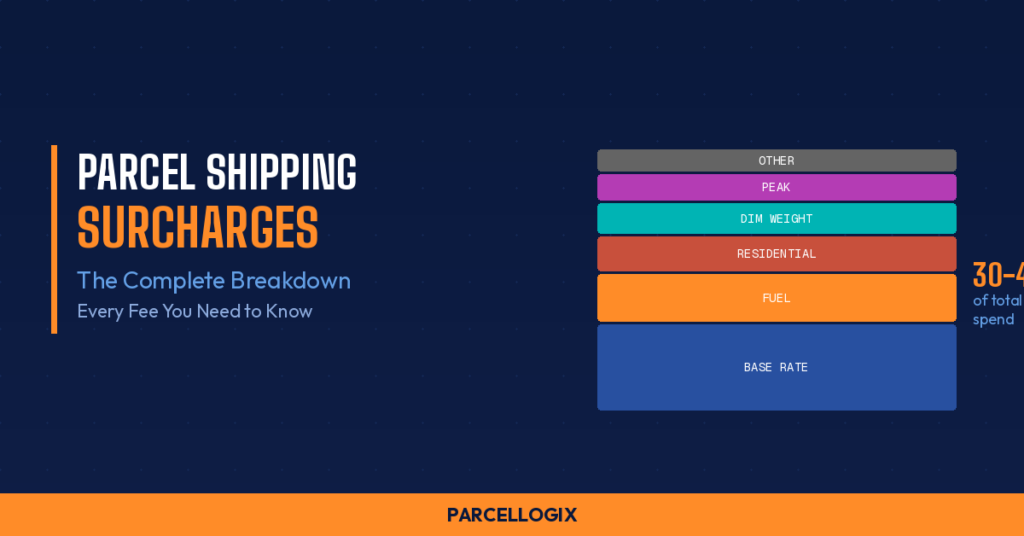
Your carrier’s base rate is only part of the story — often, the smaller part. For many shippers, surcharges now account for 30–40% of total parcel spend, and that percentage has been climbing steadily for the past five years. FedEx and UPS have gotten extremely creative about adding and inflating surcharges, effectively raising rates well beyond their announced General Rate Increases.
If you’re only negotiating base rates and ignoring surcharges, you’re optimizing the smaller piece of the puzzle. This guide breaks down every major surcharge category, what it costs, why carriers charge it, and — most importantly — which ones you can negotiate down or eliminate.
Fuel Surcharges
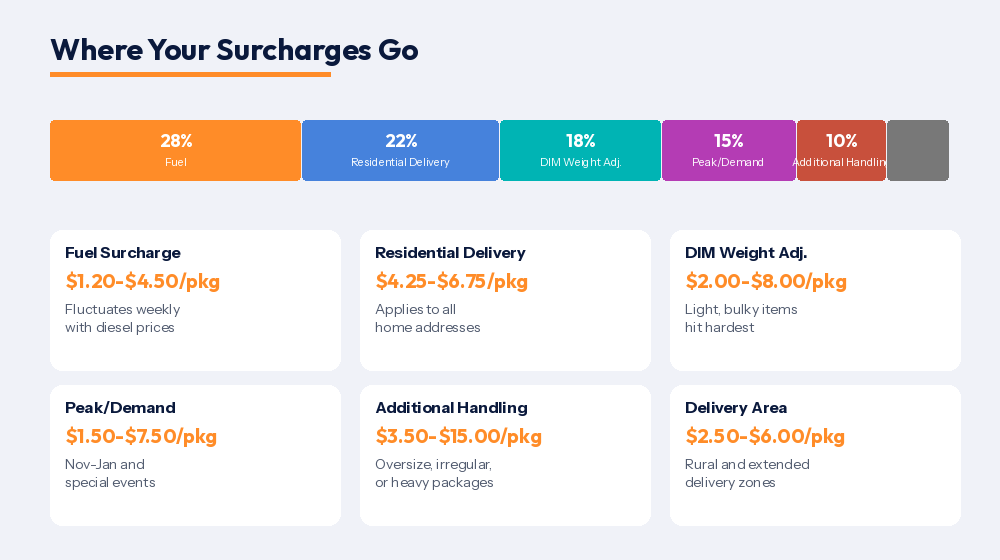
Fuel surcharges are typically the single largest surcharge category, often representing 25–30% of total surcharge spend. Both FedEx and UPS publish weekly fuel surcharge tables that float based on the national average price of diesel (for Ground) or jet fuel (for Express). As of early 2026, Ground fuel surcharges hover around 8–10% of the base rate, while Express surcharges run 14–18%.
Here’s what most shippers don’t realize: fuel surcharges are applied as a percentage of the base rate, not a fixed fee. That means when your base rates go up (via GRIs), your fuel surcharges automatically go up too — even if fuel prices haven’t changed. It’s a compounding effect that carriers rarely highlight.
Negotiation opportunity: While you can’t negotiate the published fuel surcharge index, you can negotiate a fuel surcharge cap (e.g., “fuel surcharge shall not exceed 10% of base rate regardless of index”) or a fuel surcharge discount offset. Both are common in mid-to-large shipper contracts.
Residential Delivery Surcharges
If you ship to consumers (B2C), residential delivery surcharges are likely your second-largest surcharge category. FedEx and UPS charge $4.25–$6.75 per package for delivering to a residential address — and their definition of “residential” has expanded over the years to include many mixed-use and small business locations.
The challenge is that carrier address classification databases aren’t always accurate. A commercial address might be coded as residential, triggering the surcharge incorrectly. Invoice auditing can catch these misclassifications and recover the overcharges, but proactive address validation before shipping is even better.
Negotiation opportunity: High-volume residential shippers can often negotiate reduced residential surcharges, flat-rate residential pricing, or complete residential surcharge waivers for specific service levels.
Peak and Demand Surcharges
What started as a November–January “peak season” surcharge has evolved into year-round demand-based pricing. Both FedEx and UPS now impose surcharges during any period of elevated volume — not just the holidays. In 2025, peak surcharges were in effect for nearly five months of the year across various service levels.
Peak surcharges range from $1.50 to $7.50 per package depending on the service level, package size, and the carrier’s current capacity utilization. For large shippers, peak season can increase total shipping costs by 15–25% during the affected periods.
Negotiation opportunity: Some carriers offer peak surcharge caps or waivers for shippers who commit to volume guarantees. You can also mitigate peak impact by diversifying across carriers — regional carriers like OnTrac and GLS often have lower or no peak surcharges in their service areas.
Additional Handling Surcharges
Packages that exceed certain size or weight thresholds trigger additional handling surcharges of $3.50–$15.00 per package. The thresholds are lower than many shippers expect: any package over 50 pounds, any package with a longest side exceeding 48 inches, or any package with a second-longest side exceeding 30 inches triggers the fee at both FedEx and UPS.
Packages deemed “non-conveyable” (can’t be processed on automated sorting equipment) incur even higher charges. The FedEx additional handling fee structure has been expanding steadily, adding new categories and raising thresholds annually.
Negotiation opportunity: If additional handling is a significant cost, you can negotiate higher thresholds (e.g., 55 lbs instead of 50 lbs) or reduced per-package fees. Packaging optimization to get below the thresholds is often the most cost-effective solution.
Delivery Area Surcharges (DAS)
Packages going to remote, rural, or “extended” delivery areas incur surcharges of $2.50–$6.00 per package. Carriers maintain zip code lists defining which areas qualify, and these lists expand regularly — meaning more of your deliveries may trigger DAS over time without any change in your shipping patterns.
Negotiation opportunity: DAS waivers are difficult to negotiate entirely, but reduced DAS rates and DAS caps are achievable for shippers with predictable delivery area distributions. If a large portion of your volume goes to DAS zones, this should be a priority negotiation item.
Other Surcharges to Watch
Beyond the major categories above, watch for Address Correction surcharges ($12–$21 per correction — validate addresses before shipping), Saturday Delivery surcharges ($16+ per package — often waived for high-volume Express shippers), Return shipment surcharges (some carriers charge more for returns than outbound), and hidden rate increases embedded in surcharge index changes.
How to Build a Surcharge Reduction Strategy
The most effective approach to surcharge management combines three elements. First, visibility — you can’t manage what you can’t measure. Use analytics tools like ParcelLytics to break down every surcharge by category, frequency, and dollar impact. Second, negotiation — armed with your surcharge data, target the top 3–5 surcharge categories in your next contract negotiation. Focus on the highest-dollar categories first. Third, operational optimization — some surcharges can be avoided through better operational practices: right-sizing packaging reduces DIM and additional handling charges, address validation eliminates correction fees, and shipping earlier in the day can reduce late-shipment penalties.
For a comprehensive guide to building your negotiation strategy, see our parcel shipping best practices guide.
Find Out Which Surcharges Are Costing You the Most
Our free surcharge audit reveals exactly where your money goes — and where to negotiate.
Related reading: